

Can we insure against the risks and impact of climate change?
Experts call for stronger risk management, coordinated climate action, and investment in resilience to protect communities in high-risk areas from becoming uninsurable
Australia’s insurance sector is grappling with rising insured losses and insurance premiums driven by extreme weather events and the impacts of climate change.
The insurance market is increasingly refining how it accounts for physical risks from natural hazards such as floods, tropical cyclones, and wildfires – particularly as these perils are influenced by changing climate conditions. Across states, local governments and insurers are collaborating to assess the potential impacts on sustainability, manage rising insured losses, and navigate the transition risks of a changing climate.
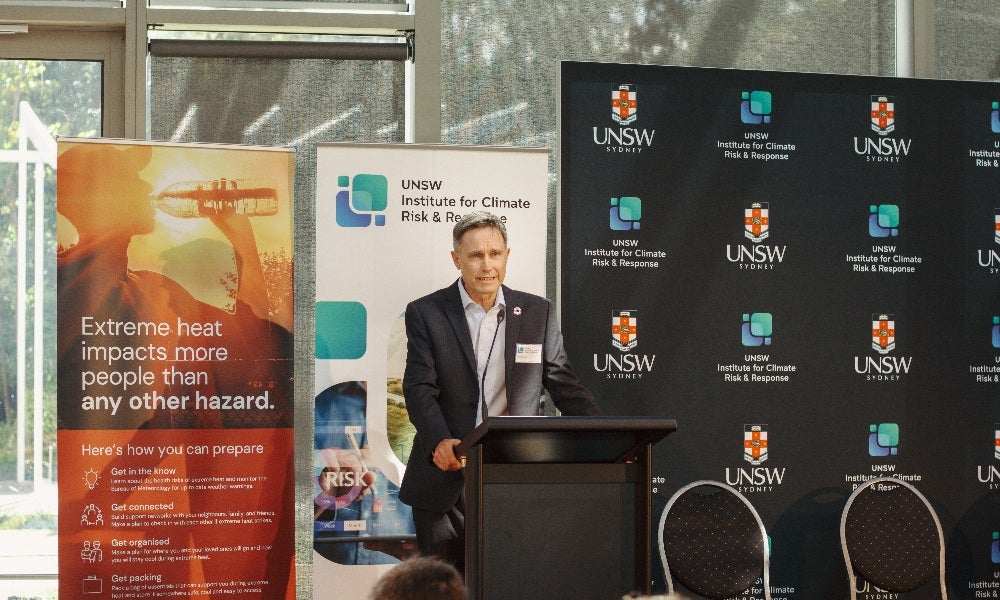
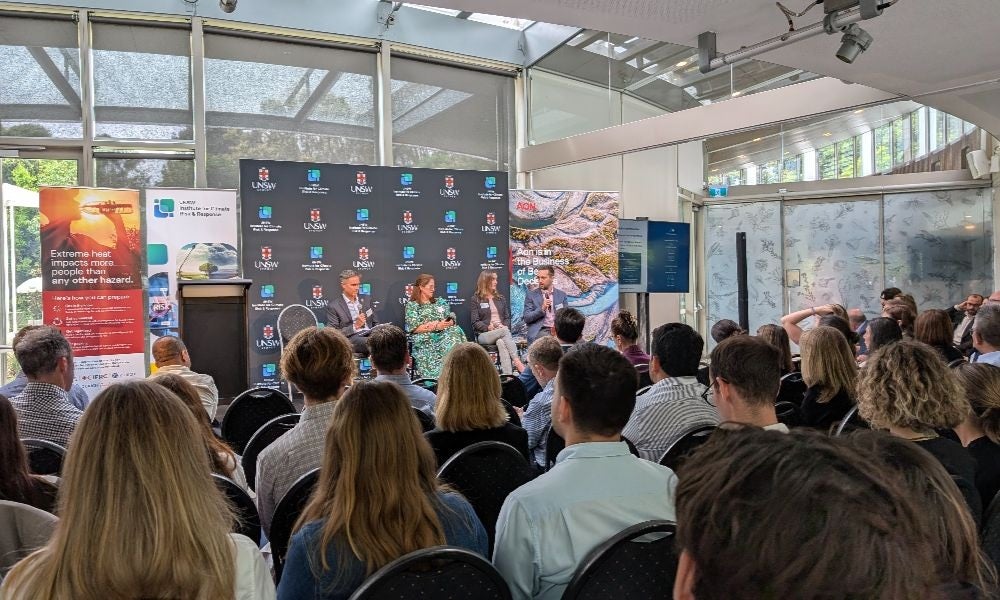
At the UNSW Institute for Climate Risk & Response Industry Forum, leaders from science, government, and industry came together to explore how industry leaders can make more informed decisions amid growing uncertainty.
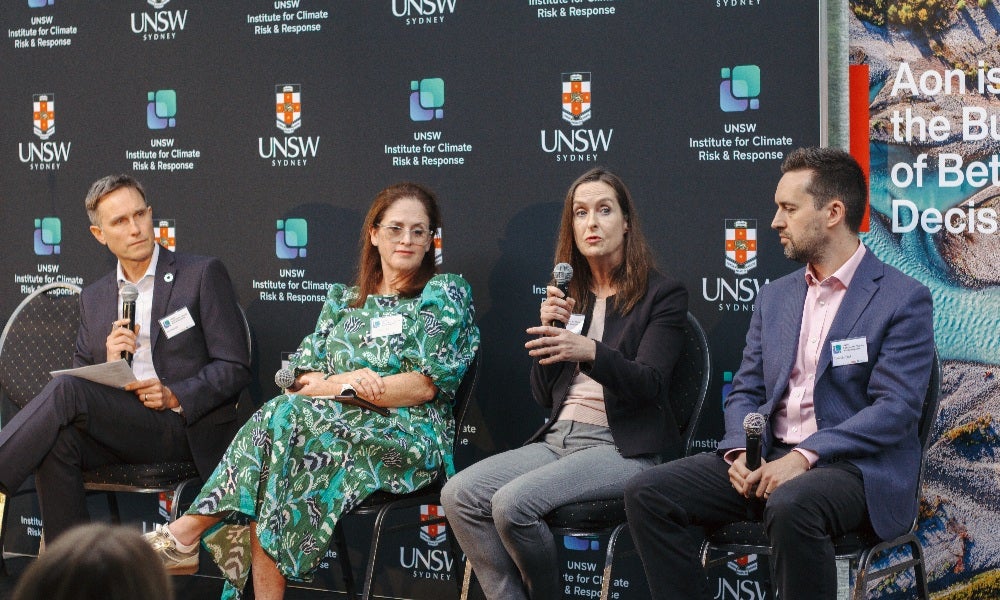
During a panel on climate risk, insurance affordability, and homeowner resilience, Professor Ben Newell, Director of the UNSW Institute for Climate Risk & Response, joined Alison Drill, Director at Swiss Reinsurance Company, Dr Tom Mortlock, Head of Climate Analytics APAC at Aon, and Kate Lyons, Chief Insurance Officer at the Insurance Council of Australia, to discuss emerging challenges in climate risk and insurance affordability, along with the latest science-based strategies and financial tools designed to address them.
Decision-making under uncertainty
As extreme weather events become more frequent and severe, the insurance sector faces growing climate-related risks that threaten communities, infrastructure, and the broader financial system.
Escalating insurance premiums and the rising cost of insurance are leaving some households in high-risk areas increasingly underinsured. In response, the insurance industry is turning to climate science, risk management, and innovative insurance products to model climate change impacts using advanced climate scenarios, scenario analysis, and enhanced climate reporting aligned with national net-zero goals.
Prof. Newell spoke about how people perceive and respond to risk in the face of mounting climate pressures. His research focuses on how individuals, businesses, and policymakers interpret probabilities and uncertainty, which is a crucial factor in understanding why adaptation often lags behind scientific evidence. “We recently did some work at ICRR looking at how people interpret these numbers, whether they really understand what a 5% or 1% annual flood risk means over time. What we find is that some people are very poor at doing those conversions. They see a small number and think, 'that’s not so bad,'” he said.
Learn more: Three climate risk challenges (and solutions) for industry
Prof. Newell noted that misconceptions about probability are widespread and can have real consequences for resilience and preparedness. “Some people think, ‘I had a flood last year, so it won’t happen again for another 50 years,’ and that kind of reasoning is very common. But probabilities don’t work that way – cumulative risk builds up over time.”
He explained that while data and probability models are vital, numbers alone are not enough to shift behaviour, particularly when it comes to motivating adaptation and long-term planning. “When it comes to talking to decision-makers, it’s fundamentally important to be comfortable with uncertainty – and to make decisions despite it,” he said. “Numbers are essential, but they can also confuse people. The trick is translating them into narratives about what a plausible future might look like.”
He added that the way climate risk is communicated – especially in terms of personal stakes – can determine whether people take action. “Once you start talking about protecting the long-term wealth of your property or your family, those are the kinds of messages that seem to cut through.”
Insurance affordability, vulnerability and adaptation
Kate Lyons, Chief Information Officer at the Insurance Council of Australia, spoke about the escalating cost of extreme weather and Australia’s growing exposure to climate-related risks. “Decade on decade, the costs of extreme weather are increasing. The impact is growing, and as we suspected, the cost for Australians is actually higher than for many other developed countries,” she said.
Ms Lyons noted that Australia’s geography and climate expose it to a wide range of natural perils, from floods and cyclones to bushfires, but that the nation’s development patterns have compounded these risks. “We’re a country of lots of different perils and extremes, but when you see these numbers, you have to ask: what have we built, where have we built, and how resilient are we?”
Subscribe to BusinessThink for the latest research, analysis and insights from UNSW Business School
Turning to the widening protection gap, Ms Lyons warned that without accessible insurance, communities face deepening economic and social vulnerability. “Without insurance, people can be left behind, unable to rebuild, unable to recover, unable to sustain their livelihoods,” she said. “When we joined flood-risk data with socio-economic data, it was striking that this is a problem in lower-income areas. Around 70% of the homes at severe or extreme flood risk are in places where the average income is below the median income and 35% below the poverty line.”
She described these findings as sobering but essential to shaping future adaptation efforts. “These statistics are low lights, but they ground the conversation about what the future looks like and how we adapt.”
Ms Lyons also highlighted the urgent need to accelerate investment in flood mitigation and adaptation. “We looked at 24 river catchments across the east coast and found mitigation projects that have been designed but never built. Time and time again, it comes down to councils needing multiple grants and studies before anything happens,” she said. “Some communities have been flooded twice in five years, even though designs for levees or dams existed but were deemed too expensive. The losses that could have been avoided are shocking.”
She added that addressing these systemic challenges requires a more pragmatic and coordinated approach. “We need to get pragmatic. Build schemes that enable money to flow where homes need to be improved so people can be safe and insured.”
Reinsurance and innovative financial tools
Alison Drill, Head Property & Casualty Structured Solutions, APAC at Swiss Reinsurance Company, highlighted the importance of collaboration across sectors in addressing the growing challenge of underinsurance and climate-related losses. Specifically, she noted that Swiss Re has estimated a 10% probability that annual insured losses could reach US$300 billion in 2025.
“The key point is collaboration – public and private sectors working together to address the underlying causes of disaster risk,” she said. “Affordability will keep worsening unless we tackle exposure and risk reduction at the source.”
From her perspective in the global reinsurance industry, innovative financial tools and partnerships will be crucial in helping communities recover more quickly from extreme weather-related impacts. One promising area, she said, is parametric insurance, which pays out when specific, independently verified conditions are met.
Learn more: Climate change and shareholder activism: what should boards do?
“Parametric insurance, where payouts are triggered by an independent event – say a cyclone passing through a defined area – can provide rapid support when it’s needed most,” she explained. “We’ve seen examples in Fiji, where homeowners receive quick payments when the power goes down after a cyclone – even something as simple as replacing the contents of a fridge can make a real difference.”
She also acknowledged that while these approaches are not without limitations, they can play a vital role in filling protection gaps. “It’s not a perfect product – there’s basis risk – but it can fill gaps where traditional indemnity insurance isn’t available,” she said.
Beyond financial innovation, she also emphasised the need for deeper collaboration between insurers, scientists, and actuaries to better understand emerging risks. “We need to collaborate with scientists and actuaries to understand what that tail risk looks like, even when the confidence level is low. Don’t ignore low confidence – it doesn’t mean zero risk.”
Finally, she called attention to the growing challenge of cascading and compounding events, as highlighted in the recently released National Climate Risk Assessment, where one disaster can amplify the effects of another. “Cascading and compounding events – like bushfire followed by flood – are areas we don’t yet model well. We need to improve how we understand and insure those sequences.”
Climate exposure, risk reduction and resilience
Dr Tom Mortlock, Head of Climate Analytics APAC at Aon, described what he calls the “Catch-22” facing the insurance sector in the era of climate change. “Climate change is leading to an increased frequency of extreme weather events, which in some areas disproportionately impacts vulnerable communities, but it’s also contributing to increasing pressures around insurance affordability and availability,” he explained.
The dilemma highlights the fundamental tension between affordability and sustainability in the insurance market. As Dr Mortlock explained, insurance itself is not designed to remove risk but to spread it. “Insurance doesn’t reduce risk – it redistributes residual risk to financial markets. The only way to break the cycle is by actually reducing risk.”
That reduction, he noted, must begin with how and where we build. “The overwhelming driver of disaster losses is exposure growth; we keep building within hazardous areas. The bullseye is getting bigger,” he said. “That doesn’t mean climate change isn’t real or impactful, it’s just that the signal is masked by how and where we’ve built.”
Dr Mortlock also pointed to the need for better national data and coordination. “We don’t yet have a national baseline for climate and natural catastrophe risks. Without a shared view of where the risks are today, it’s hard to have an efficient conversation about resilience,” he said. “Different stakeholders have different data, and if you’re reducing risk in one area, you need everyone to agree on that so the financial flows can follow.”
Learn more: Digital sustainability: technology solutions to climate change
Improving the evidence base is only part of the solution, however. He argued that creating clear incentives for investment in resilience could transform how the sector and policymakers respond to climate-related risks. “We need to articulate the cost–benefit of risk reduction, and we need to incentivise resilience. People will act if there’s a financial reason to do so,” he said. “Imagine a national digital ledger of resilience – something that records the measures put in place, so they’re reflected in insurance pricing and lending decisions.”
The experts agreed that for policyholders, governments, and the insurance sector as a whole, addressing natural disasters and the impacts of climate change will require coordinated climate action between state and local government initiatives to enhance resilience, reduce greenhouse gas emissions, and ensure sustainable home insurance coverage in a rapidly changing climate.